How to Translate Medium From Chinese to English (Step-by-Step)
Chinese-language publishing on Medium, Substack, and independent blogs is easy to find and hard to read for many readers. You search for an idea, land on a thoughtful Chinese article, and then face the same choice: copy the text into a translator and lose the original layout, or read slower than you would like.
This guide shows the shortcut — translate the page in place with bilingual translation, so the Chinese stays visible and the English meaning appears alongside it.
Demo note: the screenshots below are built in a real Medium article layout to show exactly how BothLang displays a bilingual page — the original paragraph on top and the translated English directly beneath it, with an arrow pointing at the translation. The workflow is identical on Medium, Substack, and most blog platforms because BothLang works on whatever page you are viewing.
What you need before you start
- BothLang installed in Chrome, Edge, or Firefox. The download page walks through the install.
- The extension pinned to your toolbar for fast access.
- A Chinese article or newsletter open in a tab. Both simplified and traditional characters work.
Step 1 — Open the Chinese article
Pick the page you want to read. You can open a Medium story, a Substack newsletter, or an independent Chinese blog — the translation follows the page, not the platform.
Step 2 — Set English as your target language
Open the BothLang popup by clicking the extension icon.
- Translate into — choose English (en) from the language selector.
- Page display — choose Bilingual so you see the original and the translation together.
Step 3 — Translate the page in place
Click Translate Now. BothLang walks the page and places an English translation directly beneath each Chinese paragraph. Nothing is removed — the Chinese stays, the English is added underneath. An arrow marks each translated paragraph so you can match it to the source at a glance.
The result is a bilingual page:
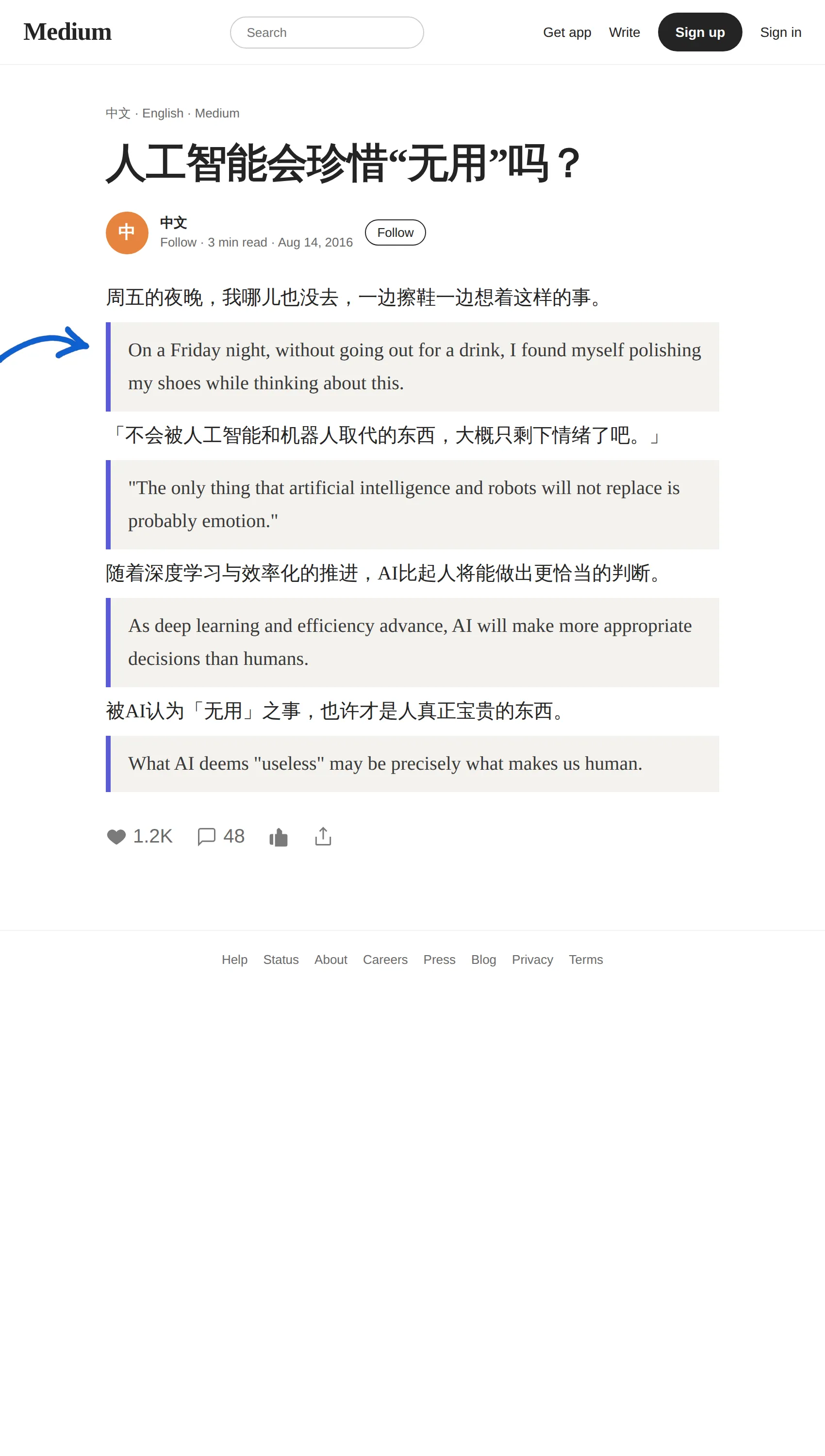
The original Chinese paragraph reads 金曜日の夜... — "On a Friday night...". Below it, the English translation appears with a small arrow pointing at it. You can read the whole article in English without losing the Chinese original for reference.
Step 4 — Adjust the reading mode
If the bilingual layout feels too busy for a long read, switch modes without re-translating:
- Original and translation (bilingual) — the friendliest for learning, because the source is always beside the result.
- Translation only — fastest when you only need the meaning.
- Original only — a clean fallback to return to the source.
Step 5 — Inspect a confusing sentence with hover translation
A single sentence can be harder to scan than a whole page. Instead of translating everything twice, use hover translation to inspect one paragraph in place. Press your shortcut (Shift, Alt, or Ctrl) and point at a paragraph — that translation appears without altering the rest of the page.
Reading simplified and traditional Chinese
BothLang translates both variants without configuration. Simplified (简体中文) and traditional (繁體中文) both convert to the same target language.
Switching source language for a different article
The language selector is per-page, so you can keep English as your target for a Chinese article and then switch to a Japanese or Spanish article without touching a global setting.
Why keep the Chinese source visible?
Two practical reasons:
- Accuracy. Names, product terms, and quoted passages can be translated loosely. The original beside the English lets you check anything that matters.
- Learning. Reading a polished Chinese paragraph next to its English meaning is a natural way to build vocabulary in context.
The short version
- Install BothLang and pin it to the toolbar.
- Open a Chinese article.
- In the popup, set Translate into: English and Page display: Bilingual.
- Click Translate Now.
- Read the English while keeping the Chinese original underneath.
Try it on your next Chinese-language article or newsletter.