How to Translate Medium From Portuguese to English (Step-by-Step)
Portuguese-language writers on Medium cover technology, AI, and culture with real depth. If English is your main reading language, the friction is ordinary: translate it in a separate tab, lose the layout, or read slower than you want.
Bilingual translation removes that trade. The Portuguese stays and the English appears directly beneath it.
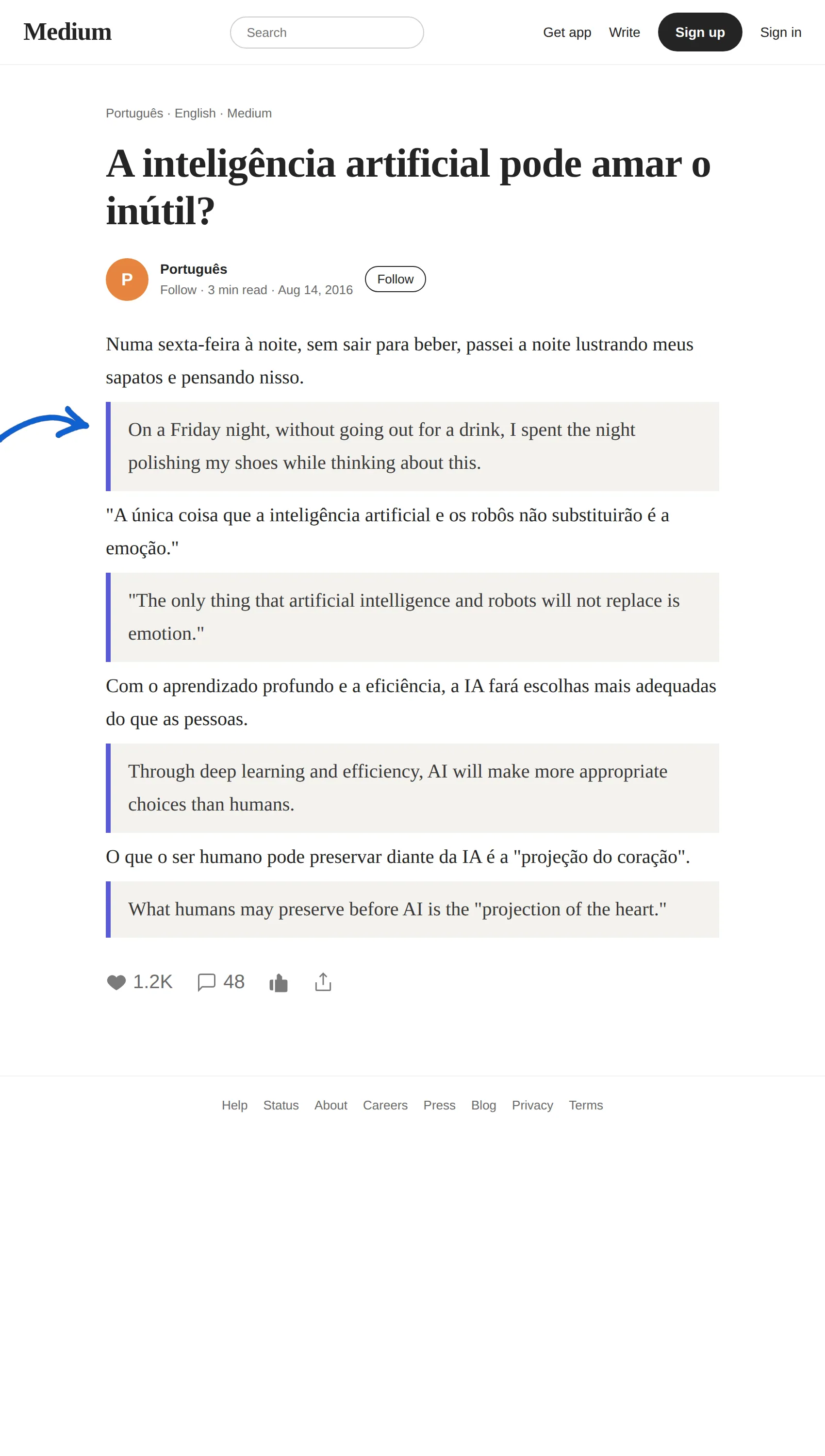
Demo note: the screenshots below are built in a real Medium article layout to show exactly how BothLang displays a bilingual page — the original paragraph on top and the translated English directly beneath it, with an arrow pointing at the translation. The workflow is identical on Medium and most blogs because BothLang works on whatever page you are viewing.
What you need
- BothLang in Chrome, Edge, or Firefox — see the download page.
- The extension pinned to your toolbar.
- A Portuguese article open in a tab.
Step 1 — Open the Portuguese article
Open the Portuguese piece you want to read. The example translates a Portuguese-language essay about artificial intelligence.
Step 2 — Set English as your target
Click the BothLang icon:
- Translate into → English (en).
- Page display → Bilingual.
Step 3 — Translate the page
Click Translate Now. BothLang adds an English translation directly beneath each Portuguese paragraph, leaving the Portuguese intact. An arrow marks each translated paragraph.
The result is a bilingual page:
Step 4 — Change reading mode
- Bilingual — source and translation together.
- Translation only — meaning only.
- Original only — clean Portuguese.
Step 5 — Hover one sentence
For a single tricky passage, use hover translation: hold your shortcut and point at a paragraph.
Brazilian and European Portuguese
BothLang handles both without configuration. It also translates Spanish or Italian articles using the same target-language setting when the page language changes.
Why keep the Portuguese visible?
- Accuracy. Names, product terms, and idioms can be mistranslated. The source beside the English lets you check.
- Learning. Reading a Portuguese paragraph under its English meaning builds vocabulary in context.
The short version
- Install and pin BothLang.
- Open a Portuguese article.
- Set Translate into: English, Page display: Bilingual.
- Click Translate Now.
- Read the English with the Portuguese original underneath.
Try it on your next Portuguese article, blog, or newsletter.