How to Translate Medium From Italian to English (Step-by-Step)
Italian-language writing on Medium is rich and easy to find. A thoughtful essay, a product teardown, or an interview bubbles up in your feed, and then the familiar question appears: translate it elsewhere and lose the layout, or read slower than you would like.
This guide covers the third option — translate the page in place with bilingual translation. The Italian stays and the English meaning appears right beside it, so you can follow the argument quickly, then check the original for any word, name, or phrase you are unsure about.
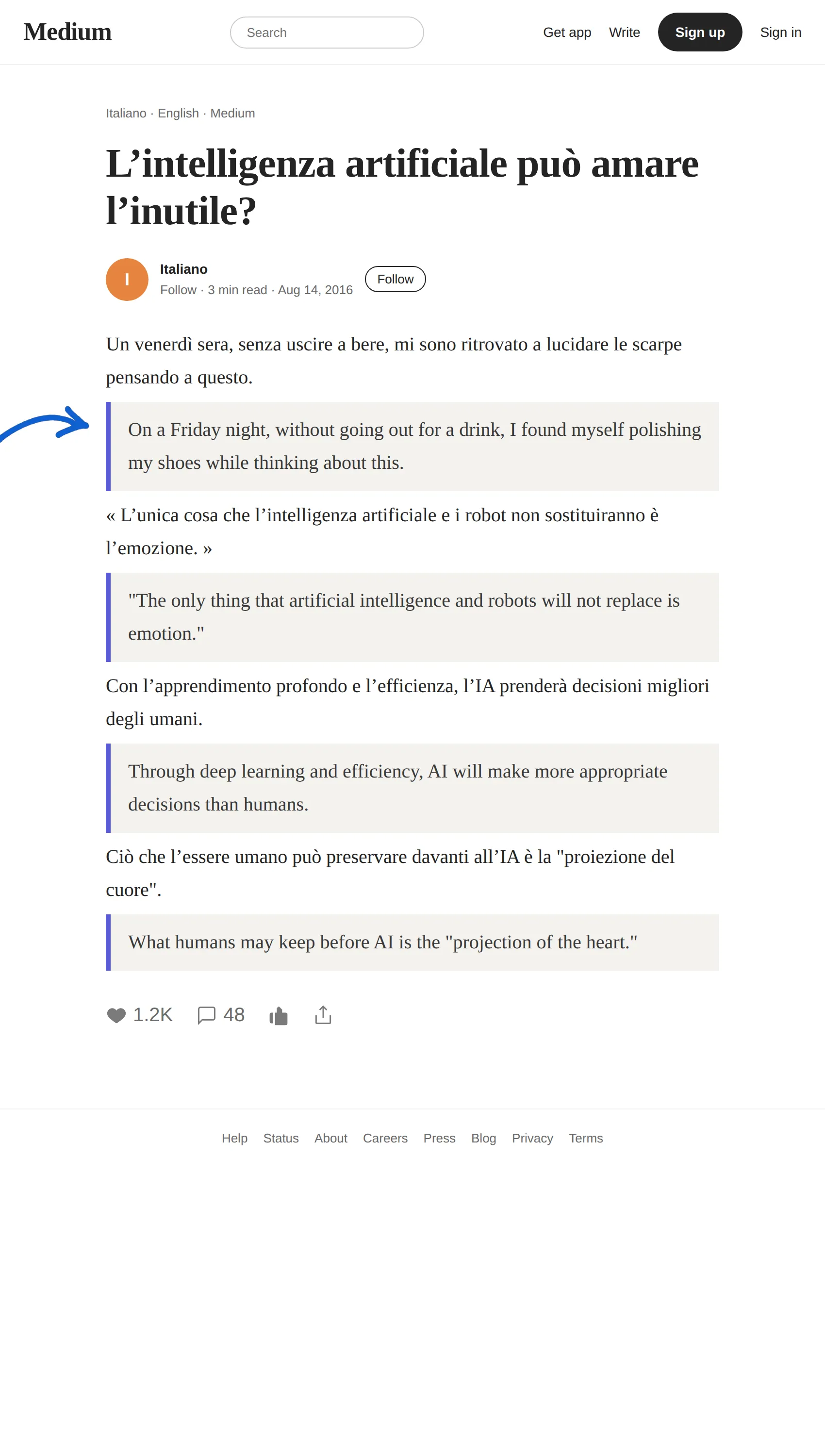
Demo note: the screenshots below are built in a real Medium article layout to show exactly how BothLang displays a bilingual page — the original paragraph on top and the translated English directly beneath it, with a hand-drawn arrow pointing at the translation. The workflow is identical on Medium and most blogs because BothLang works on whatever page you are viewing.
What you need
- BothLang installed in Chrome, Edge, or Firefox — see the download page.
- The extension pinned to your toolbar.
- A Italian article open in a tab.
Step 1 — Open the Italian article
Open the Italian piece you want to read.
Step 2 — Set English as your target
Click the BothLang icon:
- Set Translate into to English (en).
- Set Page display to Bilingual.
Step 3 — Translate the page
Click Translate Now. BothLang places an English translation directly beneath each Italian paragraph, leaving the Italian intact. A hand-drawn arrow marks the first translated paragraph.
The result is a bilingual page:
Step 4 — Switch reading modes
- Bilingual — source and translation together, ideal for learning.
- Translation only — fastest when you just need the meaning.
- Original only — back to clean Italian.
Step 5 — Hover one paragraph
For a single hard sentence, use hover translation: hold your shortcut (Shift, Alt, or Ctrl) and point at a paragraph. Only that passage is translated.
Why keep the Italian source visible?
- Accuracy. Names, product terms, and quoted lines are easy to mistranslate. The source beside the English lets you check.
- Learning. Reading a Italian paragraph next to its English meaning builds vocabulary in context.
The short version
- Install and pin BothLang.
- Open a Italian article.
- Set Translate into: English, Page display: Bilingual.
- Click Translate Now.
- Read the English with the Italian original underneath.
Try it on your next Italian article, newsletter, or blog post.