How to Translate Medium From German to Italian (Step-by-Step)
German-language content on Medium is rich and worth reading. If Italian is your stronger reading language, the usual friction applies: copy the text into a translator and lose the layout, or read slower than you would like.
This guide shows a third option — translate the German article in place, directly into Italian, with bilingual translation. The German stays visible and the Italian meaning appears right beside it, so you can read the meaning quickly and still check the original for any word, name, or phrase.
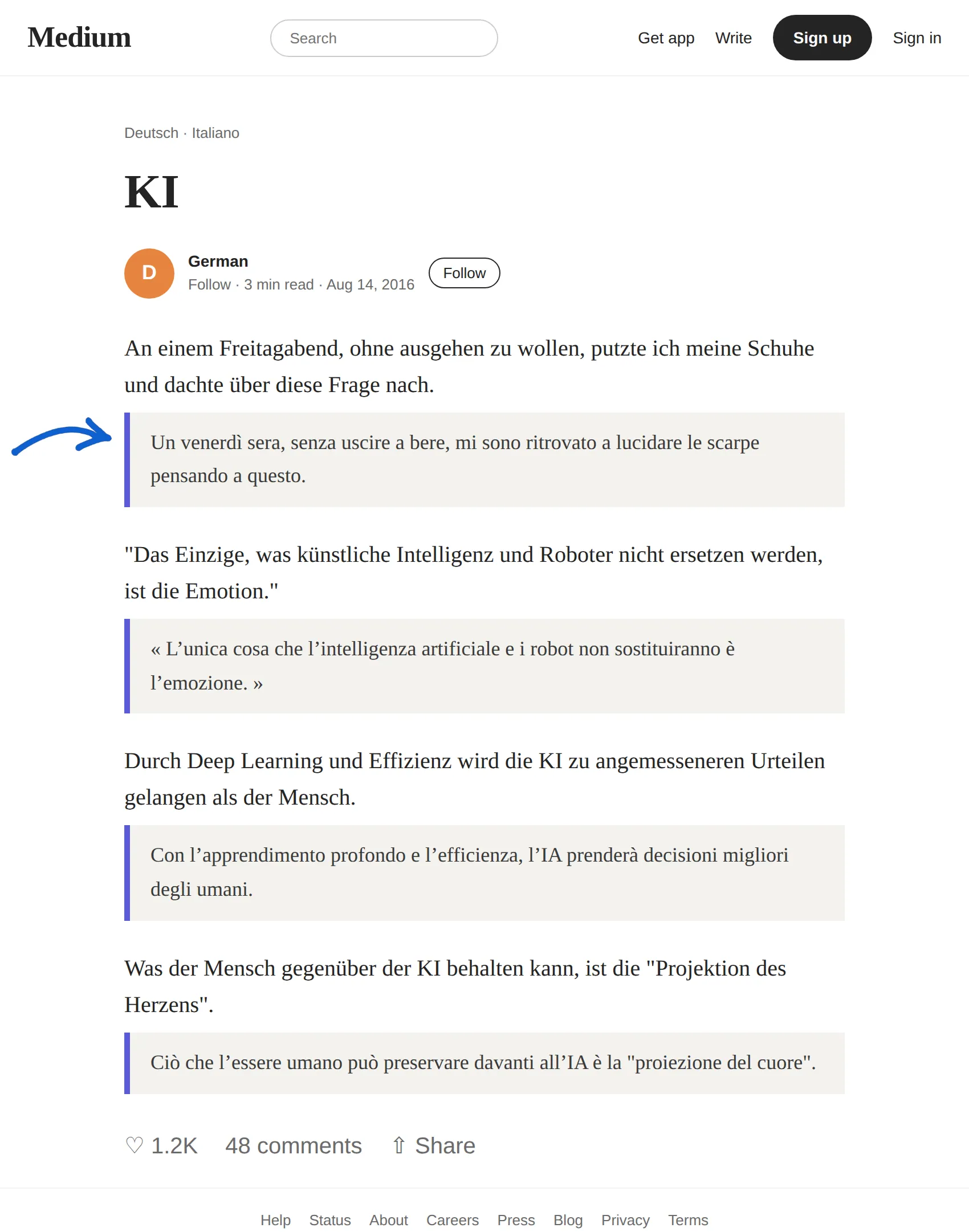
Demo note: the screenshots below are built in a real Medium layout to show exactly how BothLang displays a bilingual page — the German paragraph on top and the translated Italian directly beneath, with a hand-drawn arrow pointing at the translation.The workflow is identical on any article because BothLang works on whatever page you are viewing.
What you need
- BothLang installed in Chrome, Edge, or Firefox — see the download page.
- The extension pinned to your toolbar.
- A German-language article open in a tab.
Step 1 — Open the German article
Open the German piece you want to read.
Step 2 — Set Italian as your target
Click the BothLang icon. Set Translate into to Italian and Page display to Bilingual.
Step 3 — Translate the page
Click Translate Now. BothLang places a Italian translation directly beneath each German paragraph, leaving the German intact. A hand-drawn arrow marks the first translated paragraph.
Step 4 — Switch reading modes
- Bilingual — source and translation together.
- Translation only — fastest.
- Original only — back to clean German.
The short version
- Install and pin BothLang.
- Open a German article.
- Set Translate into: Italian, Page display: Bilingual.
- Click Translate Now.
- Read the Italian with the German original underneath.
Try it on your next German-language article.